A6 Aircraft - Based on the A-6 Intruder ground attack aircraft, the Prowler is a twin-engine, mid-wing configured aircraft that has a side-by-side cockpit arrangement. The EA-6B war fighting systems include the ALQ-99 on board receiver, the ALQ-99 pod mounted jamming system, the USQ-113 communications jamming system and the HARM missile.
The A-6F Intruder in fact was to have been an advanced version of the A-6E, initially known as the A-6E Upgrade. A contract was issued in July 1984, and it was anticipated that the A-6F would be the principal medium attack aircraft in the Fleet in the 1990s.
A6 Aircraft

The A-6E Upgrade was to have been virtually a new design, using most of the components of the A-6E but with new radar, a digital avionics suite, improved engines, the epoxy /composite Boeing wing, and additional weapons stations.
A-E Intruder
More squadrons were rapidly disestablished — VA-176 did not see the end of 1992, while stablemates VA-155 and -145 went the following year and 1994 saw the demise of VA-36 and -85. 1995 witnessed VA-35, -52 and -95 casing their colors as well.
In the US Marine Corps, conversion of the remaining Intruder units to the new F/A-18D was in full swing. It was up to the Moonlighters' of VMA(AW)-332 to finally retire the Intruder from Marine service in June 1993. It was the end of the small, but powerful, Marine All Weather Attack community, dating from October 1964 when VMA-
242 had turned in its A-4C Skyhawks for the then new Grumman Intruder. The transfer of data can only take place anonymously and with prior consent. The form of anonymisation is no longer acceptable. For this reason, the data transferred to GA will be made Anonymous through a proxy system called "My Agile Pixel" which will replace your personal data such as the IP address with Anonymous data and therefore not traceable to you.
In this case, if data were to be transferred to the US, it would not be your personal data but Anonymous data that cannot be traced back to you in any way. Two significant upgrades now in development are the Improved Capability (ICAP III) and the Multifunctional Information Distribution System (MIDS).
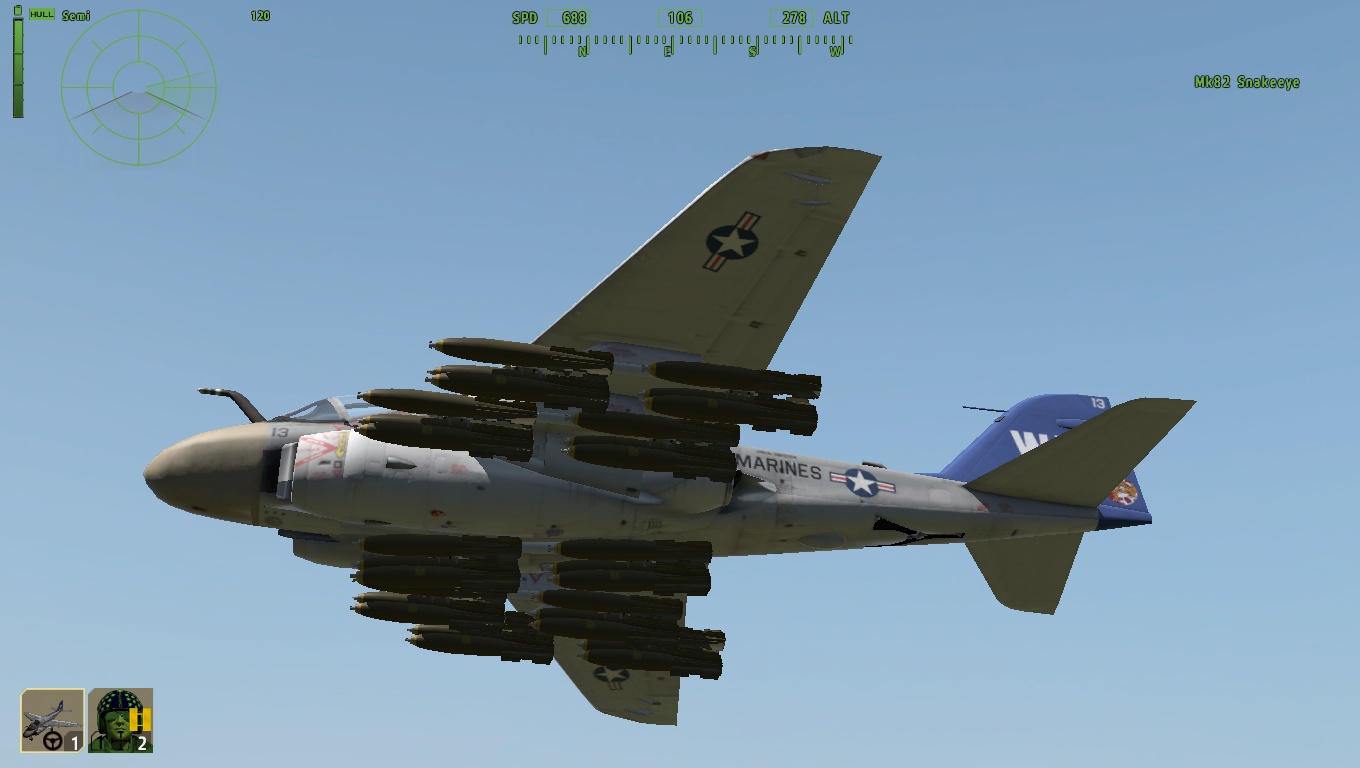
Now The Mention Of The Intruder Still Frequently Elicits Remarks Like ‘Retired Too Soon’ And ‘Wish It Was Still In The Fleet’
The ICAP III, approved for Low Rate Initial Production in June 2003, upgrades the on board receiving system, providing an accurate Threat emitter geo-locator and a selective reactive jamming Capability against modern Threat systems. The ICAP III upgrade includes new Cockpit displays, improved systems connectivity, and improved system reliability.
The 1993 Nimitz Deployment to WestPac and the 'I0' was also the last cruise for the KA-6D version, VA-165 (as part of CVW-9) taking several with it and retiring the series upon return. From this point the A-6E SWIP would be the primary model, and 'bombers' equipped with Buddy stores would carry the weight of tanking alongside air wing S-3Bs.
In the fleet, operations remained focused on post-war Iraq, for although Kuwait had been liberated, Saddam Hussein remained in control of his country and had to be watched. The result was Operations Southern Witch and Northern Watch, where large portions of Iraq were ruled as `no-fly zones' that were enforced by Allied aircraft operating from Saudi Arabia, the Persian Gulf or (from the north) Incirlik, in Turkey.
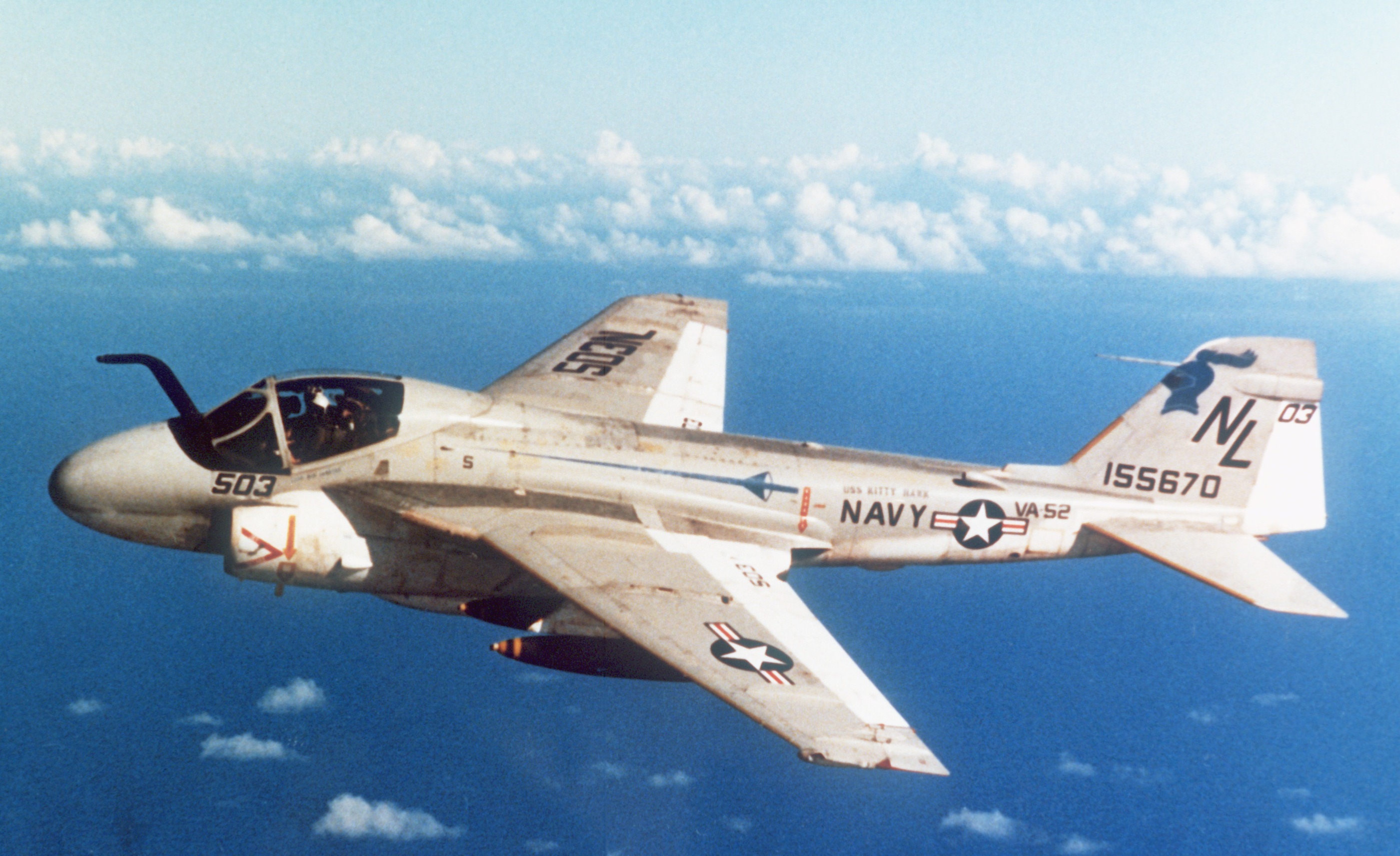
Intruders were heavily involved in these missions, working off the carriers that spent time in the Gulf and occasionally carrying out attacks on Iraqi units that fired at them. It's Jan. 23, 1993, for example, CVW-15 aircraft Flying from USS Carl Vinson (CVN-70), including VA-52 A-6Es and a pair of F/A-18As, bombed AAA sites in Iraq as part of Southern Watch.
This was almost certainly the last time an Intruder dropped Ordnance 'in anger'. Google Analytics is a web analytics service provided by Google Ireland Limited ("Google"). Google uses the Personal Data collected to track and examine the use of this site, compile reports on its activities and share them with other services developed by Google.
The 19 December 1996 launch of an A-6E Intruder from the aircraft carrier USS Enterprise (CVN 65) marked the last Intruder Squadron to fly from the deck of an aircraft carrier. The Intruder Attack Squadron 75 of Carrier Air Wing 7, known as the Sunday Punchers, was

decommissioned in early 1997. 1996 dawned with only five Intruder units left in the US Navy. While the 'Boomers' of VA-165 would get the axe, two outfits, VA-34 and -115, were selected for transition to F/A-18Cs, becoming VFA units in the change.
Which left VA-75 at Oceana and Whidbey's VA-196 as the last two standing. The 'Main Battery' had returned from its last Deployment on Nov. 13, 1996, Flying off of Carl Vinson and saying Goodbye to CVW-14, with which it had performed all but one of its 17 major deployments.
The fabled `Sunday Punchers' wheeled into the pattern at Oceana off of Enterprise on Dec. 19, having completed their final deployment with CVW-17. It was fitting that VA-75, the first Intruder Squadron to deploy (in May 1965, and directly into combat), would be the last one.
The A-6E was an all-weather, two seat, subsonic, carrier-based attack aircraft. It was equipped with a microminiaturized digital computer, a solid state weapons release system, and a single, integrated track and search radar. The target recognition/attack multi-sensor (TRAM) version of the A-6E was
introduced to the Fleet in 1979. It was equipped with a chin turret containing a forward-looking infrared (FLIR) system and a laser designator and receiver. The A-6E proved once again that it was the best all-weather
Precision bomber in the world in the joint strike on Libya terrorist-related targets in 1986. With Air Force FB-111s, A-6E Intruders penetrated the sophisticated Libyan air defense systems, which had been alerted by the high level of diplomatic tension and by

Rumors of impending attacks. Evading over 100 guided missiles, the Strike force Flew at low levels in complete darkness, and accurately delivered laser-guided and other Ordnance on target. Composite wing replacement and systems/weapons improvement programs maintained full
A-6E combat systems capability, with initial operational capability realized in FY 88 with VA-75 Deployment Onboard USS John F. Kennedy (CV 67). The US Navy's Medium Attack community was riding high after Desert Storm, having successfully participated in the most extensive combat operations conducted by US forces since Vietnam.
What they did not know was that they were only a few years from extinction as a distinct part of Naval Aviation — although it was not for a lack of trying to find a successor to the A-6E.
Since the Vietnam war, the EA-6B Prowler has been the U.S. Navy's primary carrier-based electronic warfare aircraft, jamming Enemy radars and providing an umbrella of protection for Enemy tracking systems for U.S. attack and fighter aircraft.
Back in the US Navy, if the future was not already obvious to some, it started being laid out as squadrons were rapidly disestablished. First to go was VA-185, in August 1991. Any remaining doubt as to where the Medium Attack community was headed ended in mid-1992 during an event held at Whidbey.
The US Navy's senior aviator, Vice Adm Dick Dunleavy (as OPNAV OP-05 — he had previously been an A-6 B/N and CO of VA-176), told a stunned crowd at the base Theater that Medium Attack was finished and
would eventually be rolled up into the rapidly growing Strike Fighter (VFA) community. As bad as that shock was to the Intruder crowd, not known at this point was that new, larger versions of the Hornet that were being planned (eventually called Super Hornets) would me consume both the VF and VS communities as well.
The two squadrons' disestablishment ceremonies were held on the same day, Feb. 28, 1997. Befitting Naval Aviation, there was a little gamesmanship here, however, as both squadrons arranged for 'last minute' carrier qualification periods in order to establish which unit could claim `the Last Intruder Trap'.
The 'Milestones' found a ready deck on Carl Vinson on Feb. 12-13 — this time the ship was working within sight of Whidbey in the Strait of Juan de Fuca. Not to be outdone, the 'Punchers' managed to snag an invite from Enterprise and worked the ship's day pattern with two jets on Mar.
12, 12 days after their official disestablishment. A week later the last Squadron CO, Cdr Jim Gigliotti, led the final section of A-6s to the Boneyard in Tucson, Arizona. The plane was to have been powered by a pair of General Electric F404-GE-400D turbofans, which were to be smokeless.
A third Offensive weapons rack was to be added Underneath each wing. A new Norden synthetic Aperture Radar (sometimes known as AN/APQ-173) was to be fitted, and the aircraft was to be capable of carrying the AIM-120A AMRAAM air-to-air missile, which would have given the Intruder an air
-to-air capability. The hole the loss of the Intruder made in the air wing's combat capability was huge. CVWs initially added another Hornet squadron, but that hardly improved Precision Strike and persistence capabilities. The rapid modification of the F-14 to a Strike platform went a long way to make up for the lack of true Medium Attack, but, according to supporters, did not address the 'all weather' or range benefits the A-6 provided,
let alone the value the aircraft gave as a tanker. Many of the men who flew Intruders went on to other aircraft, including Tomcats, Hornets and Prowlers. A number of them have continued to excel and rise to high leadership positions in the US Navy, and in the process have helped keep the 'Spirit of Medium Attack' alive and well in the service.
It's Jan. 7, 1991, a week before the start of Desert Storm, Defense Secretary Dick Cheney ordered the A-12 program to be canceled for 'breach of contract'. Legal details aside, it was now obvious that the A-6 did not have an apparent successor.
Throughout this period Intruders continued to deploy as part of every carrier that left CONUS. The last one built, A-6E SWIP BuNo 164385, rolled out of Calverton on Jan. 31, 1992, ending 33 years of production of 'the Mighty Tadpole'.
This historic airframe lasted barely 18 months, being lost on Sep. 8, 1993 in a mid-air collision while deployed with VA-95 on board CVN-72. While all four aircrew ejected, both jets (the other being BuNo 161682) went to the bottom of the Persian Gulf.
a6 intruder aircraft, grumman a 6 intruder specifications, a6 aircraft pictures, a6 intruder cockpit, intruder jet fighter, a6 intruder fighter jet, grumman a 6 intruder, a 6 intruder